
YouRetty · Comparative Research Guide
Semaglutide
vs Tirzepatide.
Different molecular designs. Different receptor profiles. A closer look at what direct clinical comparisons show—and how to interpret the evidence responsibly.

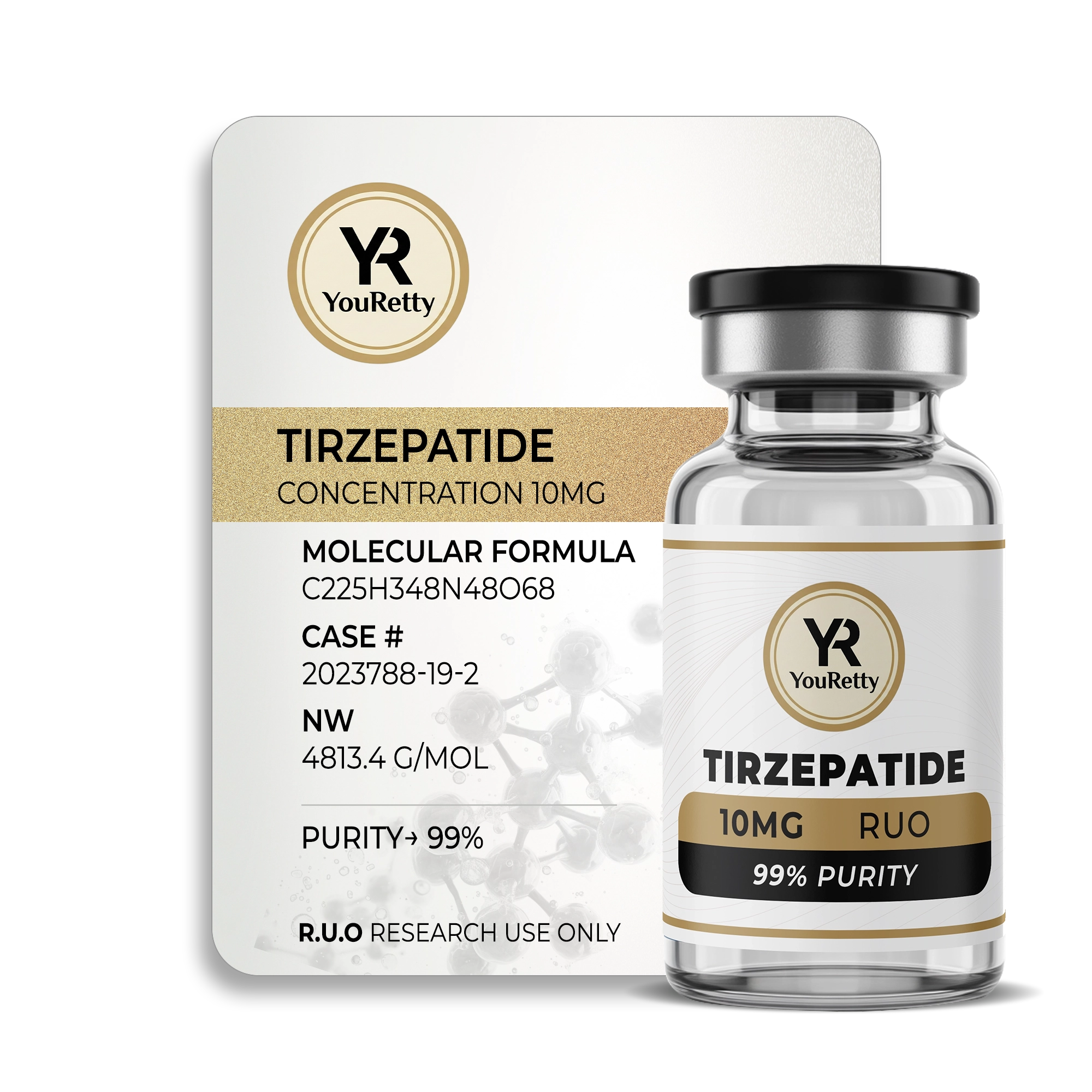
YouRetty product presentations. Clinical studies cited below did not evaluate these research-use-only vials. Product access may require membership.
01 / The Main Distinction
What Is the Difference Between Semaglutide and Tirzepatide?
Semaglutide activates the GLP-1 receptor. Tirzepatide activates both GIP and GLP-1 receptors. They are different peptide molecules, with distinct structures and evidence bases. Receptor count alone does not establish a universal ranking for every endpoint or population. [1] [2]
A meaningful comparison separates three questions: what each molecule is, what the relevant experiments or trials measured, and what documentation supports a particular supplied material.
| Feature | Semaglutide | Tirzepatide |
|---|---|---|
| Receptor profile | GLP-1 receptor agonist | Dual GIP/GLP-1 receptor agonist |
| Sequence basis | Modified human GLP-1 analogue | Modified GIP-based peptide |
| Molecular formula | C187H291N45O59 | C225H348N48O68 |
| Molar mass | 4,113.58 g/mol | 4,813.53 g/mol |
| Lipid modification | C18 fatty diacid with a spacer | C20 fatty diacid with a linker |
| Detailed resource | Semaglutide research guide | Tirzepatide research guide |
Molecular properties refer to the parent compounds, using manufacturer references. [1] [2] They are not measurements of the illustrated products or statements about material form, purity, or vial content.
02 / Receptor Pharmacology
GLP-1 vs GIP/GLP-1: Why the Mechanism Matters
Semaglutide: GLP-1 Agonism
Semaglutide binds to and activates the GLP-1 receptor. Its structural modifications support albumin binding and resistance to DPP-4 degradation, contributing to prolonged exposure. [1]
Tirzepatide: Dual Agonism
Tirzepatide binds to and activates both GIP and GLP-1 receptors. “Dual” describes the activity of one molecule, rather than a blend containing two separate compounds. [2]
Receptor activity is a starting point for understanding a mechanism. Clinical effects also depend on exposure, formulation, the population studied, and the endpoint being evaluated. It is not scientifically sound to turn the number of receptor targets into a simple potency score.
03 / Direct Comparative Evidence
What Do Head-to-Head Studies Actually Show?
Direct trials compare interventions within a shared study design. Two important examples are SURPASS-2 and SURMOUNT-5. Their populations and primary questions differ, so their findings should be interpreted separately.
Type 2 Diabetes and Glycemic Control
Frías and colleagues reported an open-label, randomized, 40-week trial involving 1,879 people with type 2 diabetes inadequately controlled with metformin.
The study compared Tirzepatide regimens of 5, 10, or 15 mg with Semaglutide 1 mg. Tirzepatide produced greater reductions in glycated hemoglobin across the tested regimens; body-weight reductions were also greater. [3]
Interpretation: This is evidence about specific clinical regimens in a defined diabetes population. Semaglutide 1 mg is not a proxy for every Semaglutide regimen or formulation.
Read SURPASS-2 on PubMed ↗Obesity and Body-Weight Outcomes
Aronne and colleagues reported a 72-week, randomized, open-label comparison in participants with obesity without diabetes, using maximum tolerated regimens.
The publication reported greater reduction in body weight and waist circumference with Tirzepatide than Semaglutide at week 72. [4]
Interpretation: This trial addresses an obesity research question. Its findings do not establish superiority for every clinical endpoint, predict every individual's response, or compare supplier batches.
Read SURMOUNT-5 on PubMed ↗Clinical regimens above are described solely to identify the comparison studied. They are not dosing or administration instructions.
A Head-to-Head Result Still Has Boundaries
Ask which population, formulation, regimen, endpoint, and follow-up produced the result. A conclusion about one outcome cannot automatically be extended to cardiovascular events, long-term safety, or another unmeasured outcome.
04 / Evidence & Safety
Why “Which Is Better?” Needs a More Precise Question
A useful comparison names the outcome first. Glycemic control, body-weight change, tolerability, and other health outcomes are different questions. A trial can support a conclusion for its prespecified endpoints without settling every other question.
- Population: A study in people with type 2 diabetes and one in people without diabetes answer different questions.
- Comparator: The actual formulation and regimen matter; the compound name alone is not enough.
- Design: Randomization improves comparability. Open-label studies do not conceal treatment assignment.
- Analysis: Review discontinuations, missing data, uncertainty, and how the treatment effect was estimated.
- Funding: Identify the sponsor and reported conflicts. Both comparative trials discussed here were funded by Eli Lilly. [3] [4]
Safety Is Part of the Comparison
Both prescription labels describe gastrointestinal adverse reactions and carry boxed warnings concerning thyroid C-cell tumors observed in rodents, with human relevance uncertain. Their complete warnings, contraindications, and adverse-reaction sections are essential context. A larger average effect on one endpoint does not establish that an intervention is safer. [1] [2]
05 / Research Material Evaluation
Comparing Research Materials Requires Separate Evidence
The trials above evaluated clinical interventions. They did not test the YouRetty vials pictured on this page. Published clinical evidence and supplier documentation serve different purposes.
ICH Q2(R2) distinguishes analytical uses including identity, assay, purity, and impurity measurement. It provides a framework for understanding methods, not proof that a particular batch meets a standard. [5]
| Question | Evidence to examine | What not to assume |
|---|---|---|
| What is the material? | Identity method, reference, exact material form, and batch identification. | A product name authenticates its contents. |
| How much is present? | Applicable content or assay result with units and calculation basis. | A purity percentage establishes milligrams per vial. |
| What was measured? | Method scope, results, limits, dates, and sample traceability. | Every quality attribute was tested. |
| Can trial findings transfer? | Evidence specific to formulation, manufacturing, and intended application. | A shared compound name establishes clinical equivalence. |
For laboratory planning, define the experimental question and required material specifications before comparing listings. A clinical ranking does not replace material characterization.
06 / Frequently Asked Questions
Semaglutide vs Tirzepatide FAQs
Are Semaglutide and Tirzepatide the same compound?
No. They have different molecular structures and receptor profiles. Semaglutide activates GLP-1 receptors; Tirzepatide activates GIP and GLP-1 receptors. [1] [2]
Does dual receptor activity mean Tirzepatide is a blend?
No. It is one molecule with activity at two receptor targets. That differs from mixing separately named compounds. [2]
Have the compounds been compared directly?
Yes. SURPASS-2 examined specific regimens in type 2 diabetes. SURMOUNT-5 studied weight-related outcomes in participants with obesity without diabetes. Each trial supports conclusions within its own scope. [3] [4]
Which showed greater weight reduction in SURMOUNT-5?
The publication reported greater mean reduction with Tirzepatide at week 72. This finding concerns the clinical interventions and population studied; it does not predict an individual's response or validate a research-use-only product. [4]
Can results from separate placebo-controlled trials be compared as if they were head-to-head?
No. Different trials may enroll different populations, use different regimens, and apply different analyses. Such comparisons need appropriate methods and cannot be treated as a single randomized comparison.
Does the same milligram amount imply equal activity?
No. Mass is a quantity, not a measure of equivalent receptor activity, exposure, clinical effect, or experimental suitability across different molecules.
Do these studies demonstrate that either YouRetty product is clinically equivalent to a prescription medicine?
No. These studies did not evaluate the pictured research materials. Identity, quality, formulation, and regulatory status require separate evidence.
Where can I read about each compound individually?
Visit the Semaglutide research guide and Tirzepatide research guide for their individual molecular profiles, references, and documentation context.
07 / Continue Exploring
Explore Each Compound in Greater Depth
Use the individual guides for molecular background and the member website for current product-specific information.
Semaglutide
Explore GLP-1 receptor activity, peptide design, and selected research publications.
Read the Semaglutide Guide View Semaglutide at YouRetty.com ↗Tirzepatide
Explore dual incretin receptor activity, molecular identity, and research evidence.
Read the Tirzepatide Guide View Tirzepatide at YouRetty.com ↗YouRetty.com uses membership access. Product links may open a sign-in or registration page first.
Scientific Sources & Further Reading
- Novo Nordisk. Ozempic prescribing information: molecular description, clinical pharmacology, and safety. This reference describes a prescription product, not YouRetty materials. Manufacturer reference (PDF).
- Eli Lilly and Company. Mounjaro prescribing information: molecular description, clinical pharmacology, and safety. This reference describes a prescription product, not YouRetty materials. Manufacturer reference (PDF).
- Frías JP, et al. (2021). SURPASS-2 comparison. New England Journal of Medicine, 385:503–515. DOI: 10.1056/NEJMoa2107519. Original publication on PubMed.
- Aronne LJ, et al. (2025). SURMOUNT-5 comparison of Tirzepatide and Semaglutide in obesity. New England Journal of Medicine. PMID: 40353578. Original publication on PubMed.
- ICH Q2(R2), Validation of Analytical Procedures. FDA guidance, March 2024. Analytical validation reference (PDF).
Source approach: this comparison uses selected original studies and official documentation. It is an educational overview, not a systematic review or a personalized treatment recommendation. No independent clinical review is claimed.